

Love at the Antenna
Sung in English
A proposal song — written for the moment before the wedding, not the day itself.
Free to start — 10 songs, no card needed.
Every couple ends up borrowing someone else’s love song for the first dance. A personal wedding song uses your names, your years, and the promises you are actually making, so the one moment the whole room watches belongs entirely to you.
Free to start — 10 songs, no card needed. · See plans and pricing
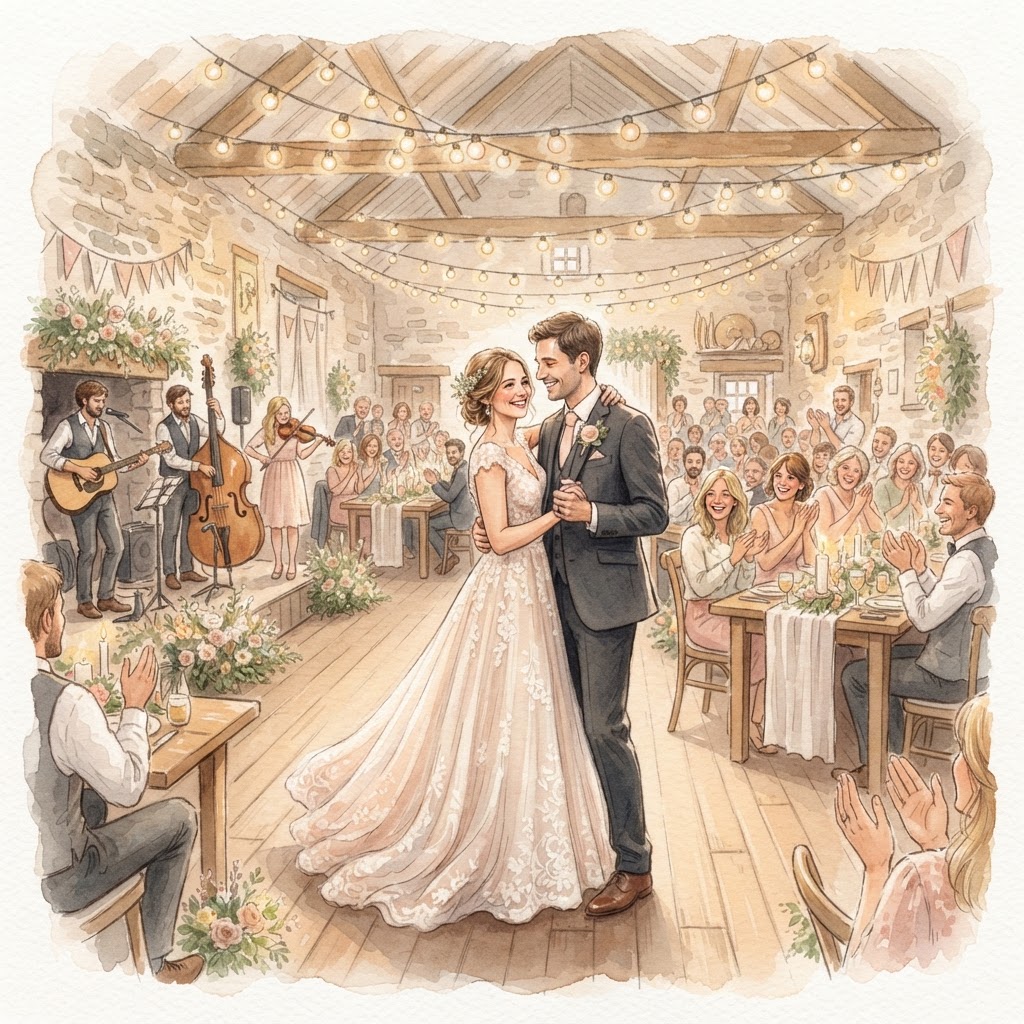
Play each recording and open its lyrics to see how names, places, routines, and memories become a song.
Sung in English
A proposal song — written for the moment before the wedding, not the day itself.
Sung in Slovak
An anniversary song — sixty years of marriage, told backwards.

Sung in Icelandic
An anniversary song — built around one repeated Sunday drive.
A first dance has to be danceable at a tempo two nervous people can actually hold, and it has to survive being listened to in silence by everyone who loves you. A ceremony piece works differently: it plays while people walk, so it can be instrumental for long stretches and only name you once. A reception song can be louder, funnier, and full of the details that would feel out of place during the vows. Choosing one job for the song is the single decision that most improves the result, because it settles length, tempo, and how much story the lyric can carry.
If you want one song to do everything, expect a compromise. A better approach is to pick the moment that matters most to you both and write for that, then reuse the same song elsewhere in the day where it fits naturally. Couples often use the personal song for the first dance and keep a familiar favourite for the entrance, so the room gets one moment of recognition and one moment of surprise.
The words that make a wedding song land are almost always specific and slightly ordinary: the flat with the broken radiator, the two years apart, the dog you adopted before you dared discuss a mortgage, the way one of you always drives and the other always navigates badly. Guests recognise those details instantly, and recognition is what makes people cry at weddings. Generic romantic vocabulary does the opposite — it tells the room this song could have been played at any wedding, including the one they went to last summer.
Give us three or four concrete moments and say why each one matters. How you met, and what you first got wrong about each other. The hardest year and what you did about it. One habit you would defend in public. One promise you are making that is not in the official vows. Then tell us what to avoid: an ex, a family rift, a bereavement you would rather mention gently or not at all. A wedding lyric is read aloud to everyone at once, so what you leave out matters as much as what you include.
For a first dance, a slow-to-mid tempo ballad with a clear pulse is the safest ground; a piano or acoustic arrangement leaves room for the words to be heard over a hall with hard floors. Motown soul suits a couple who want the room clapping by the second chorus. If either of you has a musical history — a family instrument, a shared favourite era, the style playing when you met — use it, because a wedding song that sounds like your actual taste beats one that sounds like a wedding.
Language matters more at weddings than at almost any other occasion, because the room is usually mixed. Keep the sung lyric in one language so the vocal stays coherent, choose the language the couple speaks at home, and add pronunciation notes for names, towns and family words. Print a translation in the order of service or on a card at each table if guests speak another language. The recordings above are Slovak, Icelandic and English, and none of them was flattened into generic English romance to be understood.
Send the finished audio to whoever controls the sound the day before, not on the morning. Give them the file itself as well as a link, because venue wifi fails. Agree who presses play, what the cue is, and what happens if the track starts late. Ask for the volume to be set from the middle of the room rather than the booth. If you plan to dance to it, listen to it together at least once beforehand so the first bars are not a surprise while sixty people watch.
Afterwards the song stops being a wedding item and becomes a record. That is the difference between borrowing a song for one dance and being given one: the borrowed song goes back to belonging to everybody, and yours does not.
Yes, and it is the most common use. Ask for a steady mid-tempo arrangement, listen to it together beforehand, and give the venue the audio file a day early.
No. Each recording is labelled with the occasion it was actually written for — one proposal song and two anniversary songs. They are here to show how real details become a lyric.
Yes.
Yes. Decide whose voice the lyric speaks in — the couple, the family, or a narrator — and keep that point of view consistent throughout.
Keep the sung lyric in one language and hand out a written translation. Switching language line by line makes the vocal harder to follow for everyone.
Free to start — 10 songs, no card needed. · See plans and pricing
Prices are in USD. VAT or local tax is calculated and shown by Stripe at checkout where required.